


SLOW READ: The Stand reading schedule
Welcome to Welcome to Slow Read The Stand. We are your hosts Sarah Stewart Holland and Laura Tremaine
This is the second episode of Slow Read The Stand. The Circle is open!
If you prefer to read instead of listen, below is a cleaned up transcript of the episodes as well as links to all the books and Substacks we mentioned in this episode…and several fun bonus links and videos!
Laura: Okay, here we go. Page one. Page one of 1,200. We got six months. We got plenty of time. Sarah, the circle has opened.
Sarah: I don’t even know what that means yet. I don’t even know what “the circle opens” means yet.
Laura: Well, I don’t think you’re supposed to. That’s the whole point. But what we’re discussing today is—he doesn’t call it a prologue, but it is. It’s like a few pages of prologue and then the first four chapters. But before we even do that, he kicks off The Stand with these quotes, these four quotes.
Sarah: Music lyrics.
Laura: Yeah. Well, okay, the first one... if he’d just done the Bruce Springsteen quote, I think I’d have been with him. I underlined “and try to make an honest stand.” Okay. Why did he keep going?
Sarah: I mean, he couldn’t have known that Blue Öyster Cult was going to turn into a Saturday Night Live skit, in his defense. In 1978, he didn’t know that this song was going to become such a joke. So I have a little sympathy for the second one.
Laura: Well, I think that he is really wanting you to “Don’t Fear the Reaper.”
Sarah: But all I hear is cowbell, Laura. I also feel like... starting a book off with four quotes is a little bit amateur hour. My snobbery is going to show so early in this conversation, and for the next six months y’all just know it.
Laura: Yeah, it’s like he couldn’t pick. Don’t you have an editor? But I wonder, do we know if the first edition in 1978 had all three? That’s a question I would like to know the answer to. Maybe he was like, “You know what? They made me cut the Bruce Springsteen lyric and I’m putting it back in in 1990.”
Sarah: It’s just a little excessive. Was Bruce Springsteen a big deal in the 70s?
Laura: Well, I think he was already, like, to the cool kids. He wasn’t mass popularity. I don’t know. My Bruce Springsteen education is lacking.
Sarah: I did watch the entire Saturday Night Live 50th anniversary documentary about “Don’t Fear the Reaper” and how the song came to be and how it became a part of the sketch. I can tell you more than I really should know about this song. But I don’t understand the third one. “What’s that spell? What’s that spell? What’s that spell?” That’s not even a good lyric. What’s he doing? I don’t get it.
Laura: Okay, well, that third quote... I wasn’t even sure that that was a real band. I had to look it up. Country Joe and the Fish was an American psychedelic rock band formed in Berkeley, California in 1965. Maybe the idea is that you listen to it—or hear the song in your head. Maybe it’s really more referential to the vibe of the music than the lyrics. But I’m squinting here. I’m really trying to give it the maximum amount of credit for these three, a little bit superfluous, lyric quotes.
Sarah: Well, here’s what you need to know about Stephen King. This is true in every book I’ve ever read of his. He is a real music lover. He will put music quotes or references—like how he always has characters listening to very specific songs when they’re driving the car. He never makes it generic. It is always very specific. He is a music person.
Laura: The first three are music lyrics. And then on the next page where it says “The Circle Opens,” which is the beginning of our story, there’s yet another quote. But this one is from a poet who I was unfamiliar with—Edward Dorn.
Sarah: Yeah, I’ve never heard of Edward Dorn.
Laura: His most famous work is Gunslinger, which came out in 1968.
Sarah: The poet reckoned? Yeah, what are you doing? It’s very Stephen King to me.
Laura: Yeah, it’s so literal. To me, quotes like this should really add to or create a sense of energy or vibe. This feels a little literal. But he’s such a writer for the masses, you shouldn’t need some sort of esoteric background on Edward Dorn for this to make sense to you. I’m leaning on you here. I’m just thinking, “Oh, I bet the more I read, the more these will make sense to me.”
Sarah: I don’t find the quotes in any of his books or the lyrics to matter that much. I’m sure they matter to him. And Edward Dorn, this poet, his most famous poem like I said is called Gunslinger. That is also the name of Stephen King’s first novel in his Dark Tower series. Oh no, he named that after Dorn? Like he was a Dorn fan?
Laura: And what’s also going to matter a little bit—it still isn’t that deep to me—but a pretty main character in The Stand is a big part of the Dark Tower series.
Sarah: Oh. I didn’t know there was connective tissue like that.
Laura: Oh, King’s work is very connected. He is the original Taylor Swift Easter egg. He loves to bury some of his characters as just random side characters in one story and then flesh them out in a whole other novel later.
Sarah: I love that. Like Elizabeth Strout—when she started putting Olive Kitteridge and all the people together. I’m really into that approach.
Laura: So I love Elizabeth Strout, too. It’s not quite like that because with King, they’re not all living in the same universe, really. No, because you got multiverse. Time travel. So like in 11/22/63, for example, which is one of my very favorite King books—and for those who don’t like the horror stuff, it’s so excellent because it’s time travel—in one of the portions where the character goes back to the 50s, he runs into the kids from It. Just a tiny scene. You could read it and never know. But if you know, you know.
Sarah: Well, who are we going to run into in this book? Because everybody looks like they’re going to die.
The Prologue: Charlie and Sally
Laura: So let’s start then. That’s kind of the prologue where we start with this man who is waking his wife out of a dead sleep. Turns out he should have been on the night shift, and he has her get up, get dressed, get their three-year-old baby LaVon.
Sarah: Why do they call her “Baby LaVon”? And also, another very 70s thing—because I know he wrote this in 1978 and then updates it in 1990—but the 70s is peeking through. She was sleeping in a baby doll nightie.
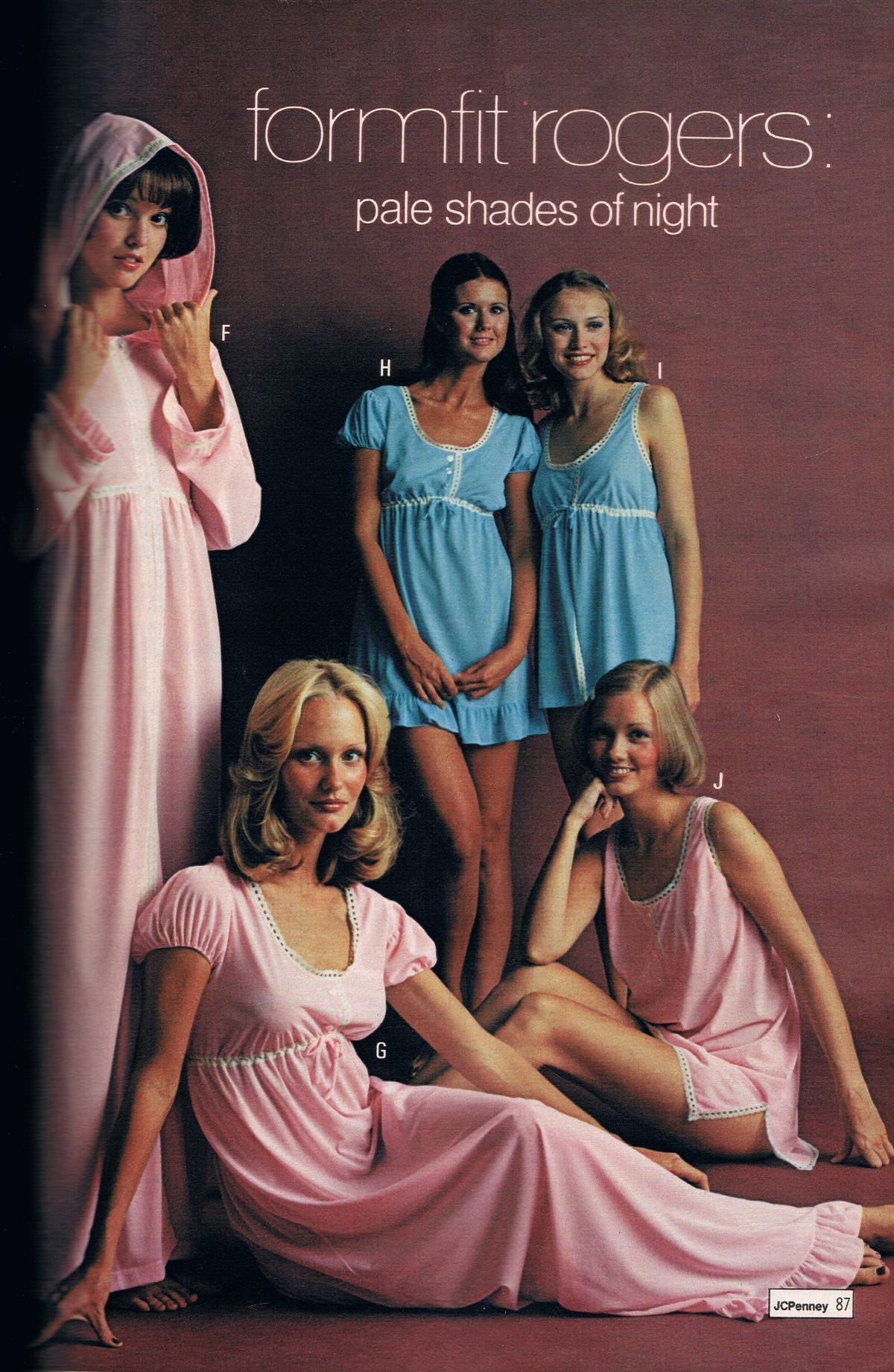
Laura: As we all do. Anyway, the woman gets up. Sally is her name. Which, listen, we’re going to take so many tangents here, but I have to tell you that “Sally” is my Starbucks name.
Sarah: That’s what you put on all your orders?
Laura: Every time. Jamba Juice, wherever. If you have to give your name, I always give “Sally” my whole life. Because my favorite story as a little kid was Judy Blume’s book starring Sally J. Friedman as herself.
Sarah: Amazing.
Laura: So Sally references always perk my ear up. Anyway, back to our people. He’s woken her up in the middle of the night. She’s so disoriented. And in the chaos, we learn that they’re on some sort of a military base where he works as a security guard in one of the towers. And when he was on shift, in the night shift, he happened to notice... right when some sort of alarm went off, the lights in his space turned from green to red. Then he looked at the security monitors where he can see inside this building that he’s guarding. And everyone inside is dead.
Sarah: Oh, my gosh. So there’s supposed to be some sort of immediate lockdown mechanism there that’s triggered when this alarm goes off. But he manages to get out in those 30 seconds.
Laura: Well, because he sees the clock turn red. He sees the clock. He’s like, “I got whatever this countdown is to get the hell out, I guess.”
Sarah: Didn’t think at all. If they’re all dead and there’s a countdown... perhaps I should not flee and expose people to other dangers?
Laura: Look, in Charlie’s defense, wouldn’t you say if he’s working in a security tower, he thinks that he’s away enough?
Sarah: No, because if you’re running, you’re in danger. That’s why you fled. If you’re in danger, then you’re in danger of other people in this scenario.
Laura: I mean, he knows there’s enough danger that he checks the direction of the wind.
Sarah: This is what I’m saying. And then it goes, “You know what I think I’m going to do? I’m going to go run right to the two people I love most in the world.” I’m going to check the direction of the wind and then run right to my baby and my wife.
Laura: They get in the car and that’s all we know. That’s the prologue. Now, I do want to say, again to the 70s of it all, I really liked it when he called her “Sugar Babe.”
Sarah: Listen, one of my first books clubs over at By Plane or By Page , we did Danielle Steel’s breakthrough novel, Passion’s Promise. In the 70s, nicknames... lots of mama, so much mama, “hey mama,” “mama this,” “Sugar Babe.” They were something. They were a real indication of their time, the terms of endearment in the 70s.
Laura: I think we should keep a running list of things that would make good merch. Sugar Babe is a good one.
Sarah: Sugar Babe is such a good one. Okay. I’m noting that.
Laura: I do not want the 70s Terms of Endearment to come back. They should die with whatever this is that’s spreading thanks to Charlie and Sally and baby LaVon’s road trip.
Sarah: Poor baby LaVon.
Laura: Not her fault. Check the wind and then go straight to my three-year-old. Good call, dude.
Chapter 1: Arnett, Texas
Laura: Chapter One. More quotes.
Sarah: Oh, God. I know. What’s he doing? Two more. I don’t even know what these are. These songs? “Baby, can you dig your man? He’s a righteous man.” These are not the lyrics I connect with. The ones that just repeat the same thing over and over again.
Laura: Okay, so The Silvers that are quoted there, they were a real band. They were an R&B band. So he’s just changing genres. Okay, branching out a little bit. I respect it. Their hit singles are called “Fool’s Paradise,” “Boogie Fever,” and “Hotline.” So, okay, that does seem relevant. He’s given us some hints. Now, the Larry Underwood song lyric, I want y’all to just put that in your pocket. I want you to just hold on to it.
Sarah: Okay. I’m putting it in my pocket. I’m going to put it in the pocket of my “suntans,” which is a clothing item I had to Google when I encountered it with Charlie. I was like, what the hell is that?
Laura: It’s just pants?
Sarah: Yeah, they’re just pants. Just a word for pants nobody uses anymore. Why this didn’t make the cut in 1990, I do not know.
Laura: Chapter One. This is one of the more memorable scenes for me in this whole story. The entire book, after Sally and Charlie, opens at a gas station in Texas, just outside of Arnett. A bunch of men are sitting around shooting the shit like they do in Texas. And one of the men, Stu Redman—this is our first introduction to Stu—he looks out the window and he sees this Chevy coming down the road, weaving all over. It slowly runs into the gas pumps.How old are you guessing Stu Redman is?
Sarah: Oh, that’s a good question. I mean, in my head, he’s kind of younger, maybe like late 30s. Because he says he has a wife that... this was quite the sentence: “The womb of his young wife had born a single dark and malignant child.” So I thought, okay, well, so he’s been married, but he seems kind of gristled a little bit. So I was guessing late 30s, early 40s.
Laura: I’d say that too, maybe. But the other guys seem older. I felt like Bill Hapscomb, the station’s owner, and a couple other of them seemed older than Stu.
Sarah: You know what felt timeless about this scene? Being in a small town, growing up in a small town, is men sitting around talking about the same things they always talk about. Inflation. Memories about a past football quarterback star that made it out of the town. Stu was no quarterback. They’re just arguing about money and politics and one of them is dumb as dirt and one of them is maybe a little smarter than the rest of the room. He nailed the group dynamic.
Laura: I totally agree. I really like the stuff about Stu—like he kind of knew he could leave, he should leave, but he couldn’t and he couldn’t really tell you why. Did it make you feel sad for him that he had to work, his baby brother got out, his other brother died, he’s stuck in the town? Or did it make you feel like he was a quiet sort of hero?
Sarah: It just made me feel like I knew him a little bit better because there’s a lot of men in this scene and it’s kind of hard to keep them all straight. And I just felt like I understood and got to know Stu in a way that I kind of like, “OK, this is the guy I’m going to pay attention to.”
Laura: You know, here’s the other thing about Stephen King that people who are new to him—it really does take a minute. If you read him a lot, you know he has so many characters. Like each scene has 10 people and he gives them all first and last names. And you’re like, well, how am I supposed to keep up from Vic, from Bill? And it’s like, these are not distinctive names. Bill, Stu, Eddie. You have to sort of trust him that you’ll learn which ones to hang on to and which ones he’s just using as an illustration. So don’t try to memorize all the people all the time. Don’t try to even draw a character map.
Sarah: That makes me feel better. Anyway, so this car crashes into their pumps. The driver is alive, but barely. He falls out of the driver’s seat. And in a car with a dead lady and a dead three-year-old. Boy, I wonder who it could be. Not only are they dead, they’re like grotesquely dead. Swollen, purple, black eyes.
Sarah: And I have so many questions about Charlie. Why was he still driving?
Laura: He says, “Are they still alive?” But from what he describes, I guess he was just in the fog of his own illness that he couldn’t see that they were very clearly dead.
Sarah: Oh, when he talks about when Charlie crashes in, and the worst part is he says something about... like, his spittle flew.
Laura: And you’re like, oh, no. Not spittle.
Sarah: No, you guys are all good and truly fucked if spittle is flying. But you also got to figure, they don’t really spell this out. And maybe we’re just hyper-aware of this because we just came through a pandemic. But you have to imagine if they have driven from California to Texas, how many places they’ve stopped. Restaurants, other gas stations, bathrooms, snacks. It’s gonna be bad. I feel like as I’m reading this, as opposed to when people read it in 1978 or 1990, post-pandemic I just feel a little bit like the gristled fisherman in Jaws where I’m like: It’s over for all y’all. I’m not even scared. I’m not even anxious for him. I’m so calloused about this. I’m just like, oh well, you’re gonna need a bigger boat.

Laura: I know, but you know, the first time I read this pre-pandemic, it’s not that my logical brain couldn’t have connected the dots of how diseases spread, but I don’t think it would have been so top of mind. I would have been more sort of willing to let it unfold a little as a reader, whereas now we immediately go to spittle.
Sarah: Yeah. And there are a lot of bodily fluids in these first couple of chapters. People have snot. People are coughing. There’s spittle. People’s bodies are swollen, full of fluids. But doesn’t that feel to you like when we all watched the opening scenes of Contagion or Outbreak?
Laura: I loved Outbreak. I love that movie.
Sarah: Where it’s showing how something spreads quickly and how often you’re just in contact with people casually and this thing is jumping around. This is like the earliest version of that.
Laura: My favorite line in that whole section, when the men are baffled and trying to figure out what is happening, is when one of the men says: “Maybe they got a poison hamburger.” It happens.
Sarah: You know what? He’s right, Laura. Considering the current state of our FDA, more right than in other times in American history. Just saying.
Laura: If you saw dead people completely swollen, would your thought be, “Well, they could have gotten a poison hamburger”?
Sarah: Definitely a poison hamburger. No. Anyway, they kind of reassure Charlie as he’s on the floor that his wife and baby are okay. We know they are not. And he dies in the ambulance. After exposing more people with his spittle. And we learn in that moment that patient zero is Charlie Campion.
Chapter Two
Laura: Chapter Two opens in Maine. Stephen King’s favorite place, right?
Sarah: That’s his place. His fictional town of Derry, Maine, is pretty infamous in horror world land. But he sets everything in Maine.
Laura: Well, it was so interesting. We get to this chapter. We get these two new people, Jess and Franny. And I’m like, well, I thought maybe you were introducing us to everybody who survives, but I definitely know all those dudes aren’t surviving. So I’m trying to figure out why are we meeting all these people as we’re going through these first chapters. I’m trying to guard my heart here.
Sarah: Franny is in this parking lot in Maine. She’s staring out at her boyfriend who’s sitting on the pier. She’s about to go tell him she’s pregnant. God, I loved this whole thing about Franny trying to figure out if she even loves this guy or not. She’s pushing on him. She really has a lot of disdain for him. But also, you know, she appears to have gotten pregnant after their very first time. I think that happened a lot in the 70s.
Laura: And she really is like, talking about the pill, and maybe she forgot to take the pill. I’m like, Franny, girl, you forgot to take it. It was kind of a funny inner dialogue. I actually think that this is when you start to see how funny King can be. I thought his inner monologue of Franny’s thoughts were actually hilarious. My favorite was: “He struck a light, and for just a moment, as cigarette smoke rafted up, she clearly saw a man and a boy fighting for control of the same face.”
Sarah: Listen, I live with a bunch of teenage boys. When I tell you that line hits...
Laura: I live with a teenage boy, too. And I underlined that line as well. That’s so good.
Sarah: And you can kind of see that Jess, the boy, he is sort of a doofus pants. Like, he does seem pretentious in the way that Franny is describing him. And yet you also sort of feel sorry for him. He’s trying. He’s blindsided by this news.
Laura: And she’s being pretty mean to him in a way. She tells him she doesn’t want to marry him. She kind of makes fun of his intellect. Well, and then he slaps her.
Sarah: This was giving 70s too. This was giving “sometimes you need a little slap.” Again, he had a chance to update this damn book. So I’m like, you left that in? In 1990?
Laura: No, but I think it definitely happens. I just think it’s less socially acceptable than it was in 1978. Because she’s not like, “Pull over right now.” She’s just like, “Well, it’s okay, you were mad.”
Sarah: It is kind of wild. But I did notice that the tone of this scene, like being with Franny and Jess, is pretty different from being in Texas with the gas station men. It was disorienting almost in a way. Because you’re like, why am I involved in this very intimate relationship conflict when I know I have this 1,200 page epic about a global apocalypse?
Laura: We don’t know what they’re going to have to do with the story, but we’re really getting sort of a scene of what’s happening in another part of the country while these other things are moving east.
Chapter Three
Sarah: Well, and I thought it was particularly interesting because it’s in such direct conflict with Chapter 3. We go back to Texas. And I felt like all this was just one paragraph after the other of: They’ve all got it. Everybody’s got it. They’re going to cough. They’ve got snot.
Laura: Well, the thing about showing up with Norm in Chapter 3, who is one of the gas station guys, is you’re getting a bit of a different peek into this sort of Texas small town. Suddenly we realize Norm is maybe younger than I thought. He’s poor. He doesn’t have food in the fridge. His wife has gone to babysit for a dollar. What was that about? Again, 1990. We didn’t want to update that?
Sarah: Also, we got the N-word. That’s a biggie.
Laura: I was like, whoa, Stephen, 1990, you left that in?
Sarah: Well, here’s the question, though. Is a character being horrendous—in this case racist—a reflection of Stephen King, or does he want you to know something about this character? If you want to know something about this character, it’s as true in 1978 as it is in 1990 as it is in 2025. We got a real insight into Norm real fast. That he is what my grandmother would call “low class.”
Laura: And just kind of... you know, also made me laugh because I think he uses the word “pissant” again. Miserable little pissant.
Sarah: That actually is a word I’m OK with bringing back. Not Sugar Babe. Pissant, though, is pretty descriptive. Maybe we should start using it again.
Laura: Well, I just wonder if in 2025, we’re not reading this book like it was written in 2025. We’re reading it in the context in which it was written. Would you show that a character was racist in a different way? These days, it feels like you just take the N-word off the table as a white author. But if he’s trying to convey something, he got it across.
Sarah: So all the gas station men are coughing. They have headaches. They have phlegm. And then Hapscomb, the owner of the gas station, is at work. He’s back at work the next day. And his cousin, who works for the state patrol, stops by to tell him that the health department is on their way. Because, turns out, what Charlie Campion had and what his family died from is contagious. And he just wants his cousin to know. In fact, it was not a poisoned hamburger. And another one of the brain trusts says, “Looks like it wasn’t a cold.” Maybe it ain’t a cold. I’m like, guys, does a cold make you swell up purple like an inner tube?
Laura: Well, and then they sort of bring up that the Atlanta Plague Center is also going to come visit. I had not heard of the Atlanta, like, CDC or whatever until COVID-19.
Sarah: Really? I feel like Ebola was always like the scary one before COVID.
Laura: Remember monkeypox? Isn’t that what Outbreak is about?
Sarah: No, that’s just monkeys. It wasn’t a monkey pox. I love Outbreak. Dustin Hoffman, Rene Russo. Put it in my veins. I loved it so much.
Laura: Maybe we should do a watch along. I feel confident it does not age well. But you know, it’s funny that we’re talking about this six years post-COVID. Are we now to a point where we can... I don’t know. I don’t want to say like laugh about it, because there’s been humorous healing all along. But what do you feel about the distance between where we are now versus like, you know, the year in 2021 where you could not read a book like this?
Sarah: Well, I mean, that’s what I’m saying. I feel good enough about it that we’re hosting this. I feel good enough about it that we’re doing a six month read along with The Stand. But I mean, like I read Station Eleven last year. There’s like a game called “Pandemic” that my husband had and I was like, get this the hell out of here. I ain’t never playing that. So maybe there were some things I was not ready for, but I feel way past the idea of: I don’t want to talk about pandemics. I think it kind of helps you process it in a weird way.
Laura: I do, too. I feel the same way, except that any trauma that I would have suffered from the COVID-19 pandemic was almost all emotional and within myself. I wasn’t working in a hospital. I didn’t lose an immediate loved one. And that’s a different experience than so many other people had.
Sarah: You know, it would be foolish to say that we’re done processing it. When COVID started, we had an epidemiologist researcher on, and she was like, “we’re still studying the 1918 pandemic.” Like, we’re still studying the data. So can you imagine how long we’ll be talking about and thinking about and writing big old fiction books about pandemics?
Laura: But or and... I don’t know, there’s been so many other things happening trauma-wise to process in the last five years on top of the pandemic. It feels like the hits have kept coming.
Sarah: Yeah. I got a bad feeling about “the hits keep coming” for our friends here in Texas.
Chapter Four
Sarah: We are at the beginning of this journey. This circle has barely opened everybody. It does feel like Chapter 3 is all just... “Oh, by the way, everybody has it.” And then Chapter 4. This is when we start to get, finally, a little bit of some explanation of what’s really going on here. Although, as we already discussed, our minds have very easily filled in these blanks a lot easier than a reader who read this before 2020. They might need to be spoon fed a little bit differently.
Laura: Yeah. And they’re talking about communicability. And I’m like, oh, people would have no idea what that means. Stephen King’s “99.4% communicability.” I’m like, oh, I’m there with you, buddy. I was already there. I don’t need Mr. Starkey back at the base to explain to me why this is bad.
Sarah: Well, and you aren’t sure when we meet Starkey, who gives us insight into Project Blue, whatever they were studying or working on... they finally give it a name: “A-Prime Flu.” But when we meet Starkey, we aren’t sure, is he a bad guy? Is he a scientist? Is he a good guy?
Laura: I mean, are there bad guys or is there just a prime flu? In my mind, even though you told me this is about the battle of good and evil... until I guess I get a little bit further in chapter four and I’m like: Is this a fucking lab leak? Are you kidding me? I had not put that together from old Charlie. But this was a lab leak?
Sarah: Yeah. Well, I think in a lab leak scenario, you still have to ask if there are good guys or bad guys here. Like, did we create this virus or were we containing this virus and it leaked or both? Was this a weapon of warfare or was this science or both? I felt there was a good and bad guy question when we meet Starkey.
Laura: Yeah, especially when he’s describing the cafeteria, which I found very confusing.
Sarah: Oh, wait, I love this part. This is one of the biggest imagery for me of the whole book. Why are people dropping dead in their soup? Is that just how fast it kills you?
Laura: It appears that this thing is very, very, very airborne. So as soon as it was out in the building, the lab... and they shut down. But I mean, it killed them before Charlie left the tower. So we’re talking about within seconds.
Sarah: I mean, I don’t know how—like this isn’t real microbiology realistic. Viruses wouldn’t kill you this quickly because they couldn’t spread. They want to spread. They want to live.
Laura: So I guess his sort of theory of the case is that in the lab, first of all, it’s more concentrated, maybe. And that’s why it’s killing these people so much more quickly. He also mentions that it mutates so quickly that you can’t create a vaccine for it.
Sarah: He also is just downing downers the whole time. Just swallowing them dry. One downer after the other. Again, very 70s coded. They love downers in the 70s. And there’s like... I don’t know. This is what also sort of made me think of like, is this a good guy, bad guy scenario versus like a neutral government program? That his son-in-law dies by suicide. The second this thing gets out, he’s like—and his son-in-law is the head of Project Blue. And Starkey is obviously some sort of high up government official. You’re also getting the hints that it was secretive because Charlie Campion, our escaped security guard, doesn’t have any proof of where he lives. He mentions that he’s been collecting hazard pay. There’s obviously a lot of secretiveness around this.
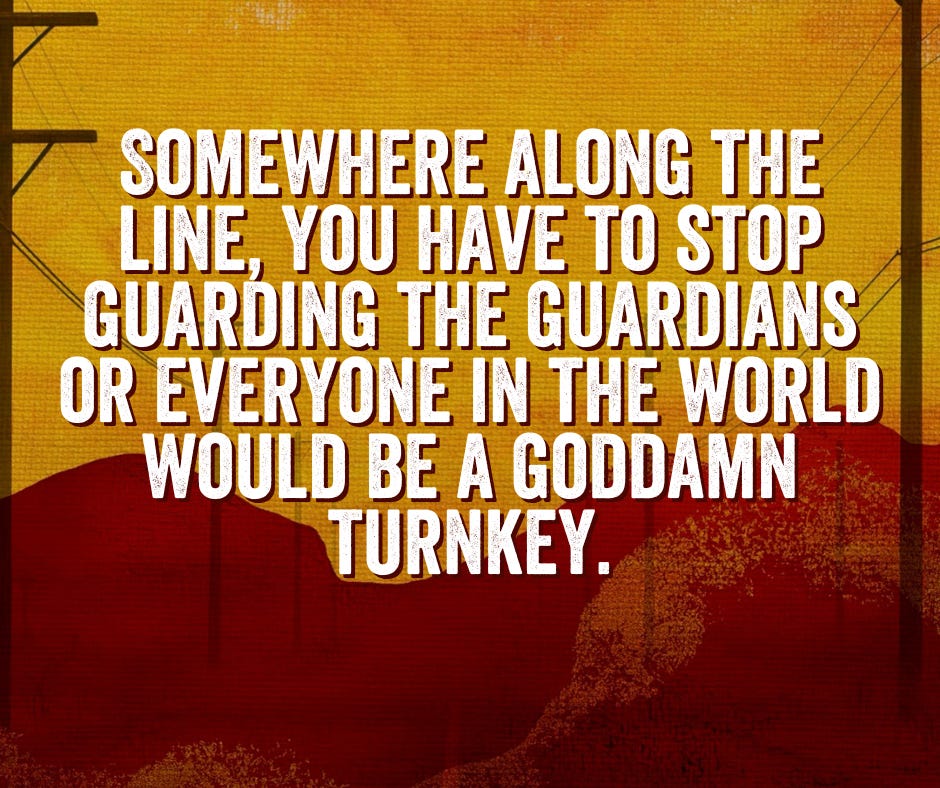
Laura: My favorite line in this chapter was: “Somewhere along the line, you have to stop guarding the guardians or everyone in the world would be a goddamn turnkey.”
Sarah: A goddamn turnkey.
Laura: Wait, I like turkey, man.
Sarah: Oh, let’s keep turkey. It’s turnkey. But that is true, kind of. You have to quit guarding the guardians at some point.
Laura: But I have to mention, we cannot move past this chapter without mentioning this image that sticks so much in my mind about this whole thing that Starkey is also obsessed with. He keeps watching the monitors of the building where everyone’s dead because he can still see the cameras working. And he’s looking at the cafeteria where people are dead by the Twinkie section. And the one guy is face down in his soup. You will spend eternity with your face in a bowl of soup. In italics.
Sarah: Suppose someone walked up to you and said you will spend eternity with your face in a bowl of soup. It’s like the old pie in the face routine. It stops being funny when it starts being you.
Laura: I mean, couldn’t that be the whole thing with The Stand? It starts being scary when it starts being you.
Sarah: Merch alert.
Laura: Okay, so that’s sort of what happened in the first four chapters. Wait, wait, we can’t move on from chapter four until we note that Arnett is under quarantine, and all the guys at the gas station are being tested, but Stu keeps testing negative.
Sarah: It’s true. Stu.
Laura: But does that mean anything? Because Charlie Campion tested negative for 50 hours.
Sarah: I think it does. I think it does. I’ve decided it does.
Laura: Only time will tell. Only pages will tell.
Homework & Next Steps
Reading Assignment:
For next week, we are tackling Chapters 5 through 15. It’s about 84 pages. We can do it!
Bonus Content:
The Side Quest: One of the bonus offerings for paid subscribers on Substack is a section called “Side Quest.” This week we’re going to talk about the logistics of carrying around a 1,200-page book that you’re reading for six months. Become a paid subscriber so you don’t miss the full discussion!


