



Welcome to SLOW READ, where we tackle the books you’ve always wanted to read at a pace you can handle.
Hosted by Sarah Stewart Holland and Laura Tremaine
We are currently reading The Stand by Stephen King (unabridged version)
You can find our full Reading Schedule here
Join the SLOW READ community on Substack for bonus episodes, book club meetings, and Side Quests with Sarah & Laura
We have come to the end of our journey with The Stand by Stephen King.
In this episode, we dissect what it all meant and what we’ll remember about this experience.
Make sure to subscribe on Substack for our next SLOW READ!
Mentioned:
Sister Helen Prejean / Dead Man Walking
The Circle That Doesn’t Close
Laura: We are here today at the end of The Stand by Stephen King to close the circle.
Sarah: But I think it’s a lie. Why did he say the circle closes? That’s not what happens at the end of this book.
Laura: That’s true. That’s totally true. But it starts with “the circle opens.” That’s the opening. So he has to close it.
Sarah: Or is it just that the circle continues? That would have been a more accurate title for this epilogue. Just saying.
Laura: I do have to say that I purposely, when I made our reading schedule for The Stand — we knew we wanted to do it for six months, like January to June, which we did — I planned it to close our circle here the same week the book opens, which is the second week of June. Just because I liked that symmetry.
Sarah: I love it. I love a symmetry.
Laura: We have a few little pages to get through, but before we do that — we will be continuing the slow read. We have picked our next book.
Sarah: I picked it and I forced it on Laura. That’s the truth.
Laura: We’re going to tell you all about that next week, where you’ll hear the reveal. If you cannot wait another second to find out the book, our paid members learned last week during our book club meeting. So you can go watch the replay of that if you just can’t stand it another second. But today we’re going to tackle “dusk of a summer evening” and the circle closing — which is a lie, because it doesn’t actually close.
Sarah: It doesn’t actually close, but there are things to say about how King ended this whole thing. Because if you do any sort of Reddit search, any sort of Googling about The Stand, what people want to talk about is the end.
Laura: Pretty much. Whether it was a true stand, or a letdown for some people, or if it’s what people expected. There’s a lot of that.
The Split Epilogue: An Epilogue for the Good Guys
Sarah: We get this kind of split epilogue, right? So we get “dusk of a summer evening.” The people we get to see from the Free Zone contingent — the good side — are Stu and Franny and Peter.
Laura: I’m sorry, three people. Babies are people too. On their journey back to Maine, they stop at Mother Abigail’s house.
Sarah: I don’t know if that path makes sense, for the record. Geographically I’m always like, where are you guys going? What are we doing? But whatever, it’s fine.
Laura: Maybe there’s something about the way you’d have to travel by foot. I’ve always thought this is weird. I’m going through all this area of the country, including Nebraska, this summer on my RV road trip with my family. So maybe I can report back to us. But they do stop at Mother Abigail’s house. They’re on the porch, the baby’s playing, and they’re talking about what happened in the Free Zone and what they think is going to happen next. It’s a little epilogue for the good guys, really. Did it feel true to you?
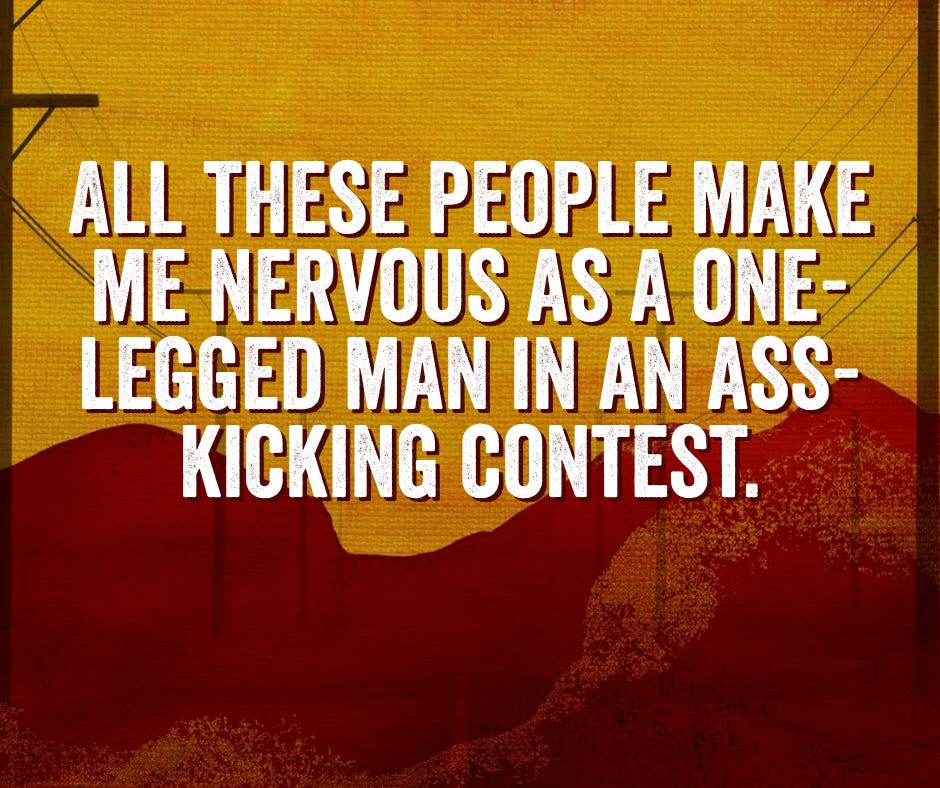
Sarah: Yeah. I think it’s true that the Free Zone would not stay together as this tight, cohesive unit. As people came together — I love this line — “all these people make me nervous as a one-legged man in an ass-kicking contest.” That’s something my grandpa would say. My grandpa always said, I want to live in the middle of 400 acres with a fence around it that says no trespassing. So to a certain contingent, living with other people is never going to be on the menu. From their perspective, the circle has closed, the threat is gone, so the need to stay close together for safety isn’t as intense. It makes sense that people would start to dissipate.
Laura: I do think it’s an interesting choice that he follows the people leaving instead of staying in the Free Zone to say what happens next. Although you’re getting reporting from them on what the next phase looked like before they left. So he’s trying to get the best of both worlds.
Sarah: I think he’s also addressing a natural question. If this really happened — but for the dreams about Mother Abigail drawing everyone to Boulder, or the contingent that went to Vegas — after a catastrophic pandemic like this, these little communities would be sprouting up all over. They wouldn’t all gather into one place. That’s the storytelling aspect, that it’s not very normal. So he’s addressing: okay, but in reality, people would dissipate. There’d be a lot of people like Franny who are homesick for their region, for their part of the country, who want to go back.
Sarah: At their last Free Zone meeting they’re ready to have a sheriff, ready to get guns — and the progression of “when we don’t have one enemy, we have many enemies” seems pretty psychologically right to me.
Do People Ever Learn Anything?
Laura: He’s making the point over and over again in this ending — even in the darker parts — that the more things change, the more they stay the same. People are gonna people. Do you think people ever learn anything? That’s the question he’s posing.
Sarah: I do. And look, there’s a way to look back over this book, and over the whole of human history, and say people are gonna people — they can be cruel, they can be violent. But the side of the coin I’m on is: yes, and the human species has made enormous, dramatic progress over the past 500 years. From the dark, peasant-and-serf-driven structure of society where how you’re born is how you die, the end — to an enormous ability to chart your own path and create peace and prosperity for the majority of people. The statistics on the children pulled out of poverty just in the last 30, 50 years are incredible. So I get what he’s saying, but I disagree to a certain extent that this is just an endless cycle, because we’ve made enormous progress. There’s no point in human history — unless you’re a crazy person who has this vision of the ‘50s that’s not accurate — where you’d want to go back in time. I don’t want to go back. First of all, I have a Type 1 diabetic child. The technology sucked just 10 years ago. I’m always going forward in time.
Laura: There’s no doubt there’s an evolution, which means we are learning as a species. We’re learning and adapting and changing. I kind of think a better question — instead of “do you think we ever learn anything” — a bigger question that feels more complicated to me is: do we think people are inherently good?
Are People Inherently Good?
Sarah: Well, we know what Stephen King thinks.
Laura: Do we?
Sarah: Well, actually, I don’t, because I think I probably sit with him. I don’t think you can categorize all people. I think there’s a small percentage that are cruel and evil and violent and dark — and some, yes, it’s a product of their circumstances and trauma, and some I think maybe there’s something else going on, and it’s just kind of baked. He dances around this nicely with the dark man. I don’t think there’s a “dark man baby,” you know what I mean? That’s the philosophical debate — would you go back and kill Hitler as a baby? Do people spring forth fully formed? I’m not naive. I understand there are cruel, violent, terrible people out there. And on the other end of the spectrum, there are people who are just naturally nice and good — and a lot of them teach preschool, you know what I mean? They’re organized a little differently. And then there’s this messy middle, where you’re deciding day to day, moment to moment, in these sliding-door moments. You’re Harold, you’re going to fall for Nadine, you’re going to lean in. Or are you Larry and you’re going to turn Nadine down? There are lots of moments where most of us — the average, the mean — could fall either way.
Laura: I think that’s one of the points of the book: most of us could fall either way. Our goodness might be circumstantial. And that’s a little bit of a hard pill to swallow, especially if you were raised to believe one of two things in a black-and-white way. If you were taught we’re all good, created in the image of God, no one can take that away — or we’re all depraved, all sinful. If you were raised with that binary, it’s hard sometimes, even if you’ve totally deconstructed, to read books like this or have conversations like this and not shake some of those old ideas. And I think he’s actually asking some of these questions in a really interesting way. Harold is a perfect and easy example, but so is Franny. If you’re raised in a certain type of home, or tax bracket, or with certain luxuries, maybe it’s easier to be good. If you’re given an opportunity for power you’ve never had, maybe it’s easier to be bad. And it’s not innate. It’s circumstantial.
Holding Both Things at Once
Sarah: Growing up, especially if you’re a teen inclined toward reductive thinking — if you’re an Enneagram One, forget being a teenager, if you’re just an Enneagram One — it’s taken me a long time to realize and be grateful for my upbringing and my faith that says: no, baby, the whole time both things were true. Every one of us is a child of God with a spark of the divine, deserving of inherent integrity and dignity. And we are also fallen, and can be harmful, and have to watch our pursuit of vice or distraction or selfishness or greed or you name it. I have this little piece of paper on my desk that my friend, who’s Jewish, gave me. On one side it says, “For you the world was created.” On the other side it says, “And to dust you shall return.” You have to hold both. Every moment is incredible and the fact that you’re here — I was talking about this with our 11-year-old — that Nicholas just happened to go to Transylvania University even though he grew up in Atlanta, and we fell in love, and that’s how Felix got here, all the things that had to align to get you here. And also that doesn’t erase that you can be a selfish jerk sometimes and you’ve got to watch it. Holding all of that is the work. The work of life, for sure.
Laura: But it feels like chaos to me to not be able to assign people into their roles. This is just my inner thoughts — it’s easier to be like, this is a good person and this is a bad person. I’m an intelligent person, I can get into the nuance and the layers. But it is scary and uncertain to feel like, oh, anybody could turn at any moment.
Sarah: But they could also turn the other way at any moment. They could do the right thing at any moment.
Laura: But I want to be able to categorize people or situations, because that makes me feel safer. To feel like I’m walking through a world where anything could happen at any time — which of course I know is true — is so scary. It’s easier for those of us who are designated Enneagram Ones, or black-and-white thinkers.
Sarah: Your devotion to Stephen King is really coming into focus for me right now.
Laura: I get why his approach to the world is appealing.
Sarah: Why? Because he’s connecting these thoughts?
Laura: Because the sorting is pretty easy. The clown is bad. The dark man is bad. The villains are easy to identify.
Sarah: They’re easy to identify, but they’re very existential. They’re not boogeymen who live under your bed. They’re not one-dimensional the way a Michael Myers, a knife-wielding kind of scary, is.
We All Hold Monstrousness
Sarah: I find it deeply comforting to live in a world where it’s all at play. Deeply, deeply comforting. I always trace it back — maybe I was just at a developmentally appropriate age — but I saw Sister Helen Prejean, the nun from Dead Man Walking. Remember Susan Sarandon? That’s her. She spoke at my college when I was a freshman about working with people on death row. And she said, vividly I remember this: when you meet someone, do you tell them the worst thing you’ve ever done in your life? No, of course you don’t. And I thought, right — we all hold monstrousness. The capacity for it. Seeing that is deeply empathizing. And especially growing up as the victim of a school shooting — the shooter at my high school was 14 years old and did something really monstrous — it’s very much informed my understanding that we all hold that capacity. That’s what we share. We share that spark of the divine, but we also share that capacity for awful, terrible things. What I react the strongest against is this idea that you can do something so bad that you lose your humanity. I really push against that. I don’t think it’s true — for me personally, ethically, morally, spiritually. There’s something about the safety of the idea that your mama, or Jesus, is going to love you no matter what. You still maintain your humanity even in the face of something truly, truly terrible. And that’s why I think King plays around with the dark man — is he human? Does he maintain his humanity? Is he even human to begin with? That’s a much more interesting way to think about terribleness: put that structure in place and say, don’t worry, they’re not living next door to you, because he’s something different.
Laura: I love that point. And I want to be clear that I don’t think our worst choices and actions define us, and I’m not walking around categorizing everybody — you’re bad, you’re good. I don’t think like that. I understand the layers and complexities of our humanity. But when I’m walking through the world, the best person I know — the thought that they could make a mistake, that these things would align and their child would die... there’s something about the idea that if you’re a good person it won’t happen to you. Bad things won’t happen to you.
Sarah: There’s something comforting to me to say: no, you could make a call, it could be the bad one, it could lead to XYZ dominoes — but you still loved your kid. You were still trying. It’s the Brené Brown, everybody’s doing the best they can. Some people’s best is dangerous and they belong in prison. But there’s something about releasing the idea that you can try hard enough and be good enough and terrible things won’t happen to you, or you won’t do terrible things. I think about this poor woman on Oprah who fell asleep at the wheel and her children died. Dr. Robin had to talk her down off the edge. That episode lives rent-free in my head. That’s what I appreciate about Stephen King. Dark things happen, man. It doesn’t matter how good you are or how hard you try. There’s a lot of dark stuff that can happen to you.
Laura: Totally. And that’s way different from what I’m talking about. An awful accident, an awful choice that led to an awful outcome, an awful diagnosis — anything that happens to you is not what I’m talking about. Not like living next to a serial killer. That’s different.
Sarah: And what you’re saying makes me think what feels so anxiety-producing to me is maybe not other people — because I definitely have the capacity to think about other people’s layers. It’s my own. I worry about my own capacity. In The Stand, what would I choose? My deepest fear is that if it came down to it, I would make the selfish choice.
Laura: We already talked about this — you’re not even leaving your house. You’re just staying there.
Sarah: That’s true. That’s totally true.
Which Side Would You Choose?
Laura: Well, we have to be self-aware as Enneagram Ones and say the appeal of order would be high.
Sarah: Totally. We just need to be honest about ourselves. But also, I like to sing the national anthem, so I’m still pretty sure I’d end up in Boulder. All the group singing and the clapping and supporting each other — I’ve got to believe my extrovertedness would win and I’d end up there. Also, I don’t like being bossed around. I’m not going to live with a dark man. I like to be in charge. I just like the woo-woo of the dreams. I know who’s going to get me in the dreams. I am devoted to Mother Abigail. I’d need one dream and I’d show up with 500 people I brought with me, because I’m an enthusiastic disciple.
Laura: Yeah, we differ there. I left the evangelical church, but you can take the girl out of the church, you can’t take the evangelical out of the girl, let me tell you. I still hold a grudge against Mother Abigail a tiny bit, but her beckoning through dreams appeals.
Sarah: You would be with her. You wouldn’t be like, I better go with the guy who’s freaking me out in my dreams.
Laura: No, we’re too old for that. We would go with Mother Abigail.
Sarah: No, we would, for sure. See, we’ve talked ourselves down. We’re good.
Laura: Boulder would be appealing, but Mother Abigail’s voice would be stronger. I am more tied to the divine. I am not drawn to darkness in real life. I love dark stories.
Sarah: Says the lady who holds Stephen King in summer.
Laura: I know. I love dark stories, and it’s a mental experiment. But in real life I am not drawn to darkness. I don’t like a haunted house. I barely own any black clothing — this is actually true. I do not like darkness. I feel a lightness in my real life. So it’s always been interesting to me that I’m drawn to dark literature, and dark literature only. I don’t like dark music. My husband’s obsessed with Metallica. No, sir. I don’t do anything that feels like that. Nothing. Except horror literature. It’s just where I channel it all.
Sarah: I read a book and I was like, this book was a delight, and you’re like, that doesn’t sound good to me. I’m like, who is opposed to delight?
Laura: You described a book to me before we pressed record using the words “precious” and “adorable.” And I was like, yeah, I’m out.
Sarah: I should have said scary and frightening.
Laura: Precious and adorable will not make it to my shelves.
The Actual Epilogue: Randall Flagg Wakes Up Again
Sarah: I was really here with our buddy for all this philosophical debate — everything I think he’s saying, I get it, I’m with him. I didn’t like these last four pages with the circle not closing at all, just opening in a new place. Tell the truth, Stephen. Tell the truth.
Laura: You mean when we turn to the actual epilogue with Randall Flagg?
Sarah: Yes. I didn’t like it. He just wakes up in a new place gathering new people. I didn’t like it.
Laura: I did like it.
Sarah: Ugh.
Laura: Because it felt, again, really true to me. Evil never dies.
Sarah: Okay, but we went through this many pages. Can’t we get a nice clean ending? Look how many pages. So many pages.
Laura: Okay, so if you put aside what might have felt itchy about Randall Flagg popping up in the Amazon among Indigenous people —
Sarah: Yeah, there’s a little bit of itchiness there.
Laura: So let’s name that and put it aside. I do think the fact that they fall to their knees and start worshiping who they think has come to save them — this is obviously so sarcastic and awful — but it felt true to me. There’s always going to be, throughout history, time, and region, someone claiming that they alone can save you.
Sarah: Yes. You’re right. Cult leaders, people who will lead you astray — all those points he’s making, I thought it was very well done. And he’s not particularly long-winded. He managed to do it in a few pages.
Laura: At least it wasn’t long.
Sarah: I do kind of have a beef. We run into this a lot in politics, where I feel like the conversation, or the policy goal, is “we’re going to get to a place where nobody’s violent or nobody has bad parents.” That’s probably not going to happen, guys. That’s utopia. It doesn’t exist. We’re always going to be humans — I guess until the robots take over — but we’re always going to have evil or selfishness or greed or violence. We’re not going to policy our way out of that. We can definitely improve the situation, and we have, we’ve done a really good job, but there’s no end road. There’s no finish line where we did it, we fixed it, and people will stop behaving badly in perpetuity.
Laura: And some of these figures, historically and culturally, are almost like reincarnations of each other. So Randall Flagg becomes Russell Faraday. He has to cycle through the different languages. He’s an agent of evil. He’s not even sure where he is exactly, but he’s going to figure it out. He’s not worried about it.
Sarah: This is giving one of my favorite books I read, I think two years ago. It’s called Blazing Eye Sees All. Have you read it?
Laura: I have not.
Sarah: It’s so good. I highly recommend it. The structure is around that lady who turned herself purple with colloidal silver and they held her dead body around for a while. You know who I’m talking about?
Laura: Oh, yeah. The Love Has Won lady.
Sarah: The author uses her story and then tells the story of all these other female cult leaders in America over the last hundred years. And there’s been a fair share. The similarities of how they appeal to people, what their downfalls are — it’s just a cycle. One of the really interesting parts I think about all the time, particularly when we talk about the dreams: there’s this moment where they talk about how women in particular, but all people, have spiritual experiences. That is a thing people have. There’s evil in the world, and there are also strong forces of spirituality and good and woo-woo, whatever you want to call it. And because we have such a materialism-focused, post-Enlightenment culture, your options are: everybody’s going to tell you you’re crazy, or you can go to the cult leader who tells you you’re not crazy and welcomes you with open arms.
Laura: [The person who] has subscribed to too many conspiracy theories — and then when it turns out they’re right, it’s really hard to give that person credit. It’s almost impossible, because we don’t want to believe the crazy people might have been on to something.
Sarah: Might have a direct line to something else.
Laura: We want people like that to just channel it into the literature. Just put it right on the page, friends. I liked the ending. I liked the epilogue, because it’s not “evil conquers all” and it’s not “good conquers all.”
So Did Good Actually Win?
Sarah: Good won.
Laura: Did they really win? Vegas got nuked by their own person.
Sarah: Yeah, a lot of people died. But by their own hand. They were destroyed in that moment, but we’ve already established well into the book that there are good and bad people in both Boulder and Vegas.
Laura: So it didn’t really accomplish much, and it didn’t even kill Randall Flagg. That’s what was frustrating to me. So there is no winner.
Sarah: I guess we don’t know when this happened. Okay, I’m going to add something. This — the circle closes — in fact happened 500 years in the future. See, look, I fixed it. So we got a happy ending for 500 years. That seems reasonable considering how many people died in the plague. Randall Flagg, the dark man, was out of commission for 500 years. Spread the word, Stephen King fans. I just added a little detail to The Stand that I think is helpful.
Laura: It still doesn’t close the circle, though, to your original point.
Sarah: No, it doesn’t. Why did he say that? It’s not closed. You said the circle closed — oh, by the way, he’s back. No, friend.
Laura: But is it the nature of a circle that it goes on and on? So it closes and then starts again?
Sarah: I guess so. Time is a flat circle.
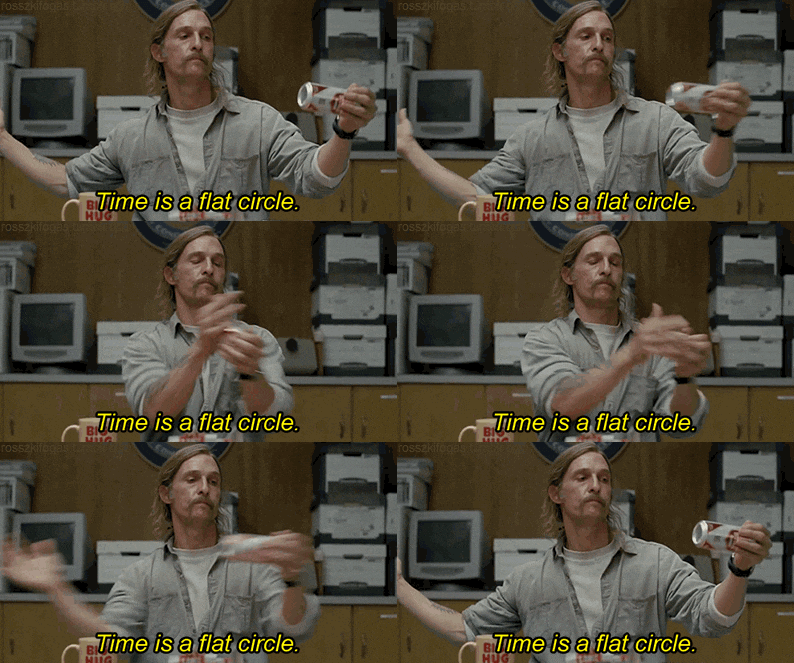
Laura: You sound like Matthew McConaughey from True Detective. Speaking of dark content. I’m not going to say Stephen King originated any of these theories — many of them he did not — but he put them into pop culture in a way that has resonated with the masses. And there are a lot of derivatives of his stories. Now I hope slow readers start to notice that. Oh, this is a reference to The Stand, this is a reference to the dark man. Once you start reading Stephen King, you have no idea how many things are a nod to him.
Sarah: Well, you’ve made me a Stephen King fan.
Laura: So the real question is, have I made you a Slow Read fan?
Sarah: Yes.
Laura: Okay, good.
What Slow Reading Did
Laura: I’m very curious, because our next Slow Read — which we’re not saying on this episode — is not a book I’ve read before. So I’m curious to see if it feels different, if I feel a different urgency, if it’s harder to slow read a book I haven’t read before. I could slow read The Stand without urgency because I already knew how it was going to end.
Sarah: Fun fact, I’ve never slow read a book I’ve read before. I’ve only slow read new books.
Laura: Oh, so you had a completely different experience.
Sarah: What was really different for me this time is that I slow read a modern piece of fiction. All my other slow reads — I guess Wolf Hall is pretty modern, but War and Peace, Don Quixote, Brothers Karamazov — they’re all classic pieces of literature I’ve taken my time with. So it was different to read something with more plot propulsion. But I still really enjoyed slow reading it. First of all, it just makes a big book less intimidating. It doesn’t feel like, oh, I’ve got to get through this book. I like the feeling of, I’ve checked it off my list, I’ve read what I’m supposed to read, I don’t have this big heavy book hanging over my head that I should be reading all the time.
Laura: You just read your pages and then you’re done and you did it. That’s a really nice way to read, because people aren’t only intimidated by the book, they get weighed down by it. You’re like, should I be done by now? Should I be reading more? You “should” all over yourself when you pick up a big book without a slow read.
Sarah: Some of those books you named that you’ve already slow read — they’re harder books, weightier, they take more mental capacity. So when you do your 50 pages and put them down, you’re almost like, okay, I did my homework. The Stand isn’t necessarily that.
Laura: So I’m curious if you felt like drawing it out was to the benefit of sitting in the story, or if it was more like, this isn’t the type of book we need to slow read.
Sarah: No, no. I really felt like it was good, because you got to sit with so many things he was experimenting with, instead of rushing through to find out what happens. I can promise you this: if I’d read this on my own, as quickly as I wanted to, I wouldn’t be able to tell you much about The Stand in six months. But the way we did it, the story’s baked in. I know the details.
Laura: That’s what I find. When I read something slowly, I take it in a lot better and remember it a lot better, as opposed to reading for plot, wanting to find out what happens. I’ll go through my Goodreads and be like, I read that book — I don’t remember reading that book. I read it so quickly.
Sarah: And the talking-about-it aspect was really important to me, because it made me think about what I wanted to say about it to you, to our slow readers. This would also be true in a book club. I hope it’s true for slow readers listening to our conversation, that you think about a book differently, or appreciate it differently, when you do it in a book club conversation — because hearing people talk about it also tattoos it onto you in a way.
Reading Every Word Aloud
Laura: I think it’ll be interesting as time goes on which parts of the story I felt like I lived in the most. Particularly the beginning. The beginning of the pandemic in The Stand was really intense and felt very immediate, like I was experiencing it — more than once we get to Boulder and the characters come into play. I’ll be interested to see if I feel that way in six months or a year. And I’m interested to know from you, with the reread slow read, what parts stood out, or if they were the same parts you’ve always been into.
Sarah: I do want each of us to share our favorite parts. But a huge part of this slow read for me was that I read every single word aloud.
Laura: I still think you should have recorded at least one chapter for the people.
Sarah: Maybe I’ll do something else. Maybe you can do “the circle closes,” even though it doesn’t. A little bonus or something.
Laura: Maybe we’ll do that.
Sarah: It really changed it for me, reading every single word aloud. It started as a gimmicky thing for myself, because it was a reread — a way to keep me interested and really help me understand the text we were going to describe on the microphone. But what it made me do was: you can’t skim. Anything you’d kind of skim, especially on a reread — even the boring, sloggy parts of The Stand that I would have read fast — I couldn’t. I sat in my living room, my whole family knew I was doing it, I read aloud, and I did voices. I did everything. And that made me connect to some of the smaller characters a lot more — the Judge, Dana. When I’m reading their actual words aloud and giving them voice and character and spirit, it really brought things to life in a whole different way.
Our Favorite Scenes
Laura: Since you brought up Dana — that’s my favorite scene in the whole book, Dana’s showdown with the dark man.
Sarah: Really?
Laura: Yeah, she’s such a badass. I really, really love that chapter.
Sarah: Did you feel connected to Dana before then?
Laura: No. Well, that’s my favorite part. When you said that, I was like, yeah, that’s my favorite part. But then I’m like, is it the Mother Abigail chapter where we learn about her life story? Can I have a tie? Can I have two? So mine are the Mother Abigail life story and Dana’s showdown with the dark man.
Sarah: My favorite — I talked about this when we read it — this is such a dark scene, y’all. I just love when the Project Blue people are dead.
Laura: You and the Dinty Moore.
Sarah: Well, I thought you were going to say the kid.
Laura: That’d be worse. I’ll give you the Dinty Moore. That’s fine.
Sarah: When they’re describing the guy face-down in the soup, but then also the people who decide to have sex in their last few minutes of life, the guy who puts the sign around his neck and sits down in the hallway. That scene, the descriptions of that whole situation, are so gnarly and so terrifying. This is what is horror to me. We can even talk about whether you find this book to be horror, but that is horror to me, even though it’s not descriptive graphic violence. They’re dead, but it’s not graphic. It’s just so scary. When I think of The Stand, that’s what I think of.
Laura: I wonder if the section that will stay with me the longest — not necessarily my favorite, but I think about it a lot — is the second wave, where people die of accidents and the kid falls down. That one was rough. That was the most emotionally affecting for me, especially because there were children involved. It’s like, which one were you wrapped up in, but which one did you keep thinking about? It’s a big book, lots of pieces and parts and chapters and characters. It’ll be interesting to see what sticks with you over time.
Sarah: The other big image that stays with me is Harold riding on the barn roof. That little scene tells us so much, now that we’re done, about who Harold is or could be. He’s in love with Franny, Franny’s pregnant and having to travel with Harold, who she doesn’t even like. All those early dynamics stick with me so much. I’m more interested in Harold than I am in Stu, ultimately, as a character. Franny’s sort of our every-person, the stand-in, and Stu is too a little bit. They’re our stand-in for the everyday person. So I really like those early days with Franny and Harold.
Laura: It’s interesting that both of us are naming primarily first-half-of-the-book scenes.
Sarah: I think so. Where he’s putting the pieces together toward the end is interesting, but it’s not as affecting as the first half.
Laura: I can’t wait to hear from all our slow readers — which parts stuck with them, whether they liked the first half or the second half, and which characters they’ll be thinking about for a long time. I think this will be a fun conversation to have in the comments as we close the circle.
Closing the Circle
Sarah: He might not be closing the circle, because we’ve got another book to read.
Laura: We’re closing the circle. The circle is closed. It’s closed here on The Stand.
Sarah: Slow Read: The Stand — we’re going to change the name. Got to figure out when we’ll make the switch. The name is going to change, the graphic is going to change, the colors are going to change.
Laura: So good. I can’t wait for people to see it. Should we tell people the genre? But it’s genre-bending, so I guess we can’t even do that. Our next book is genre-bending in the same way The Stand is genre-bending. A little bit. I mean, I feel like The Stand is considered horror. But did you think this was scary?
Sarah: No, not really. Just the kid. That section, I would have been fine never reading. I would have been okay.
Laura: And that section was cut from the original version.
Sarah: You should have left it on the cutting room floor. It’s brutal. That is horror. Although — and I was going to say not in a way that helps — Trashcan Man’s ultimate fall apart, maybe you do need that interaction with the kid. Maybe that’s why they put it back in. It’s rough out there. But is that horror, or is that — I don’t know, thriller? There needs to be a word for when the horror is not supernatural, it’s just other human beings, and it’s not crime. It’s not really mystery. Maybe thriller. That’s why it’s genre-bending: it’s hard to figure out where to put this book, because it’s the pandemic, but then something else comes on the scene and you’re dealing with a lot of other threats and fears.
Laura: Including tunnels. God, I hope nobody reads this book who’s already afraid of tunnels.
Sarah: Oh yeah, that scene. The Lincoln Tunnel for sure. You’re bad off. But not just that — there’s more than one tunnel.
Laura: There is more than one tunnel. But the Lincoln Tunnel — I hope you don’t start this book with a few tunnels, or you’re in trouble. I also feel like we haven’t even said Larry’s name on this whole final episode.
Sarah: I did, I talked about Larry.
Laura: Oh, you did. At the beginning. Sweet Larry. Sweet, sweet Larry. Figuring out, making the choices — because remember, he turns to a good man now. That’s right. And Glen Bateman, also one of my favorite characters in the whole book.
Sarah: They’ll live in our hearts forever, even as the circle closes and we move on.
Laura: And again, if you cannot wait until next week to find out, you can go ahead and become a paid member of our Substack — because we should probably tell you now, the next book is going to be for paid members only.
Sarah: So if you want to hear — we might be really unfiltered.
Laura: You’re going to hear why in next week’s episode, when we talk about why we picked this book. And listen, you should subscribe and get the Side Quests and listen to those over the next few months, because they’re really good. They’re some of the best conversations we had — about everything from death to how we met.
Sarah: The Stand will stay in your feed if you want to start over, or tell someone else who’s been meaning to slow read The Stand, or read it at all. They can read as fast as they want, because now all the episodes are out there.
Laura: And just thanks, everybody. This has been really fun.
Sarah: Thanks, Laura, for saying yes to my invitation to slow read The Stand. It was so fun. It was so gratifying. I’ve never done anything like this in all my podcasting years, and it really enhanced my reading in the first half of 2026. I hope that’s true for everybody, because I’m passionate about reading and doing it in different ways and making it fun and interesting and adding to our life in such a chaotic world. It really matters to me. It’s one of my missions. Doing it with you was amazing.
Laura: It’s been a blast. As we read about pandemics and violent killers.
Sarah: And a nuke explosion at the end.
Laura: It’s been a blast, you guys. Pun intended.
Sarah: You really stuck the landing. Excellent work, my friend.
Laura: We’ll see you next week, where you can learn about our next stand — our next choice for Slow Read.
Sarah: Thanks, guys.
Laura: See you on the other side.
Next Up: Next week we reveal our next Slow Read — a genre-bending book Sarah picked (and forced on Laura). It will be for paid Substack members only. Paid members can get a head start now by watching the replay of last week’s book club meeting, where we announced the pick.


